In modern gold cyanidation processes, the use of environmentally friendly gold dressing agents is essential to ensure both efficient gold recovery and safe environmental performance.
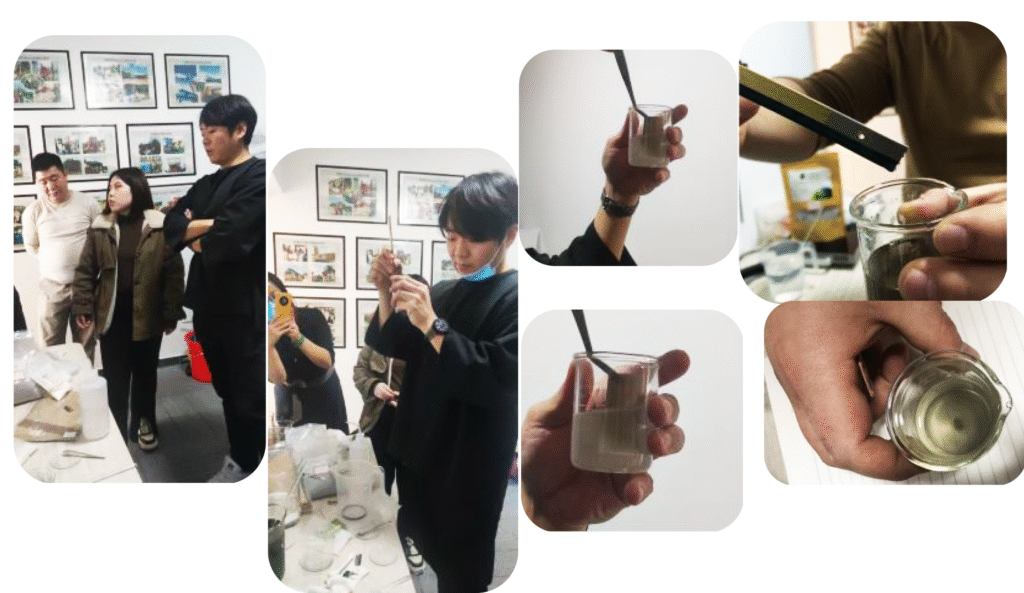
On January 23, 2024, Dasen Mining welcomed a group of customers from South Korea to our central laboratory in Shaanxi Province, China, to conduct a series of gold selection agent testing experiments.
The testing was overseen by Mr. Park, a Korean customer working closely with our technical engineers and laboratory staff.
Experimental Details
Purpose of the Experiment:
To evaluate the performance of five gold dressing agents with different active ingredient concentrations.
Each agent was tested to observe its chemical reaction with the client’s electronic gold‑plated components, as well as to measure the:
- Gold dissolution time
- Solution color changes
- Formation and characteristics of reaction precipitates
These indicators help determine the reactivity, stability, and effectiveness of each gold dressing agent in real industrial conditions.
Date and Location
Date: January 23, 2024
Location: Dasen Mining Laboratory, Shaanxi Province, China
Customer: Mr. Park (South Korea)
Experiment Conducted By: Dasen laboratory technical team
Instruments and Reagents Used
50 mL beaker
10 mL big‑belly pipette
Basic burette
Plastic dropper
Testing agent:
Dissolve 1.7331 g of silver nitrate (AgNO₃) in distilled water and dilute to 1 L in a brown volumetric flask
Store in a cool, dark environment
Chromogen (rose red silver reagent):
Add 0.02–0.05 g of p‑dimethylaminobenzylidene rhodanine (C₁₂H₁₂N₂OS₂) to 100 mL acetone
Store in a brown reagent bottle away from light
Experimental Objective and Evaluation Criteria
A total of five deplating tests were conducted using five distinct gold dressing agents.
The gold dissolution rate, solution coloration, and precipitate formation were observed carefully under controlled conditions.
The effectiveness of each agent was evaluated based on:
- The speed of gold dissolution
- The clarity and color change of the leach solution
- The type and volume of sediment formed during the reaction
These results provided valuable data to help the customer identify the most efficient and eco‑friendly reagent for electronic waste gold recovery.
The following are actual pictures taken during customer experiments:
| Time: | January 23,2024 | Location | Shannxi,Xi’an | Experimenter: | MR PARK(Korean customer) |
| Text No Product | First | Second | Third | Fourth | Fifth |
| Stripper agent | 20g(best) | 0.51g(best)+1.5g(another stripper) | 0.58g | 1g | 0.5g |
| gold dressing agent | 40g(Tag:G) | 1g | 1g(The first sample sent) | 1.09g(J-1,33) | 1.02g(J-2,32) |
| NaOH | 8g | 0.2g | 0.2g | 0.2g | 0.2g |
| Water | 1L | 50g | 50g | 50g | 50g |
| Process | Put the stripping agent, gold dressing agent, and NaOH in a large beaker, add water to the beaker, and the experimenter will stir for one minute with a stirring rod. Next, the experimenter will use tweezers to clamp the electronic gold-plated parts and let them stand in the beaker for reaction. | ||||
| Reaction time | One minute, no change | One minute, no change | 30 seconds, gold dissolves in liquid | 30 seconds, gold dissolves in liquid | 16 seconds, gold dissolves in liquid |
| Text description | There is a layer of black sediment at the bottom of the glass beaker, and the clear water turns into a gray-black solution | The solution in the beaker is turbid and the clear water turns into a brown solution | The gold on the electronic gold-plated parts is completely dissolved, and the water is very clear and pale yellow. | The gold on the electronic gold-plated parts dissolves in the beaker, and the clear water turns into a brown liquid. | The gold on the electronic gold-plated parts dissolves in the beaker, and the clear water turns into a gray liquid |
| Text results | Unqualified | Unqualified | Qualified, best effect | Qualified, but the liquid in the glass beaker was cloudy, but the customer was not satisfied | |
| Text Pictures | 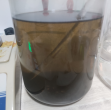 | 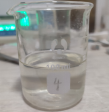 | 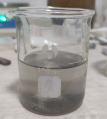 | ||
The customer observed clear differences in performance among the reagents.
Through this cooperative experiment, Dasen Mining demonstrated its ability to provide accurate testing data, custom chemical formulations, and technical support for international clients developing non‑cyanide or low‑toxicity leaching systems.
Whatsapp:+8613319277356
Email: chemicals@oremagnetic.com
Recent Posts
-
 How Did Mongolia’s 5,000 t/d Heap Leaching Project Boost Gold Recovery with Eco-Friendly Reagent A+?
 -
 Why Choose Dasen for Your Sodium Cyanide Gold Extraction Needs?
 -
 Why Does Built Labs Improve Zimbabwe’s Gold Processing Profits?
 -
 What Makes 95% Efficient Activated Carbon the Top Choice for Zambia’s Gold Recovery?
 -
 10TPD CIL Plant to Ghana is nearing completion